Heads up: this page has affiliate links. As an Amazon Associate, Vent & Valve earns from qualifying
purchases at no extra cost to you. Full disclosure.
Check both ends and the route between themMatch the washer and valve connections, hose length and bend space. Follow the appliance and hose instructions for installation and replacement.
Best for: the default upgrade. Most laundry rooms should just buy these
Budget
Eastman is a plumbing-parts house, not a brand invented for a marketplace listing, and this
pair is the straightforward answer for most machines. Eastman describes the build
as a PVC core, braided nylon reinforcement, a clear vinyl shell and a stainless braid made
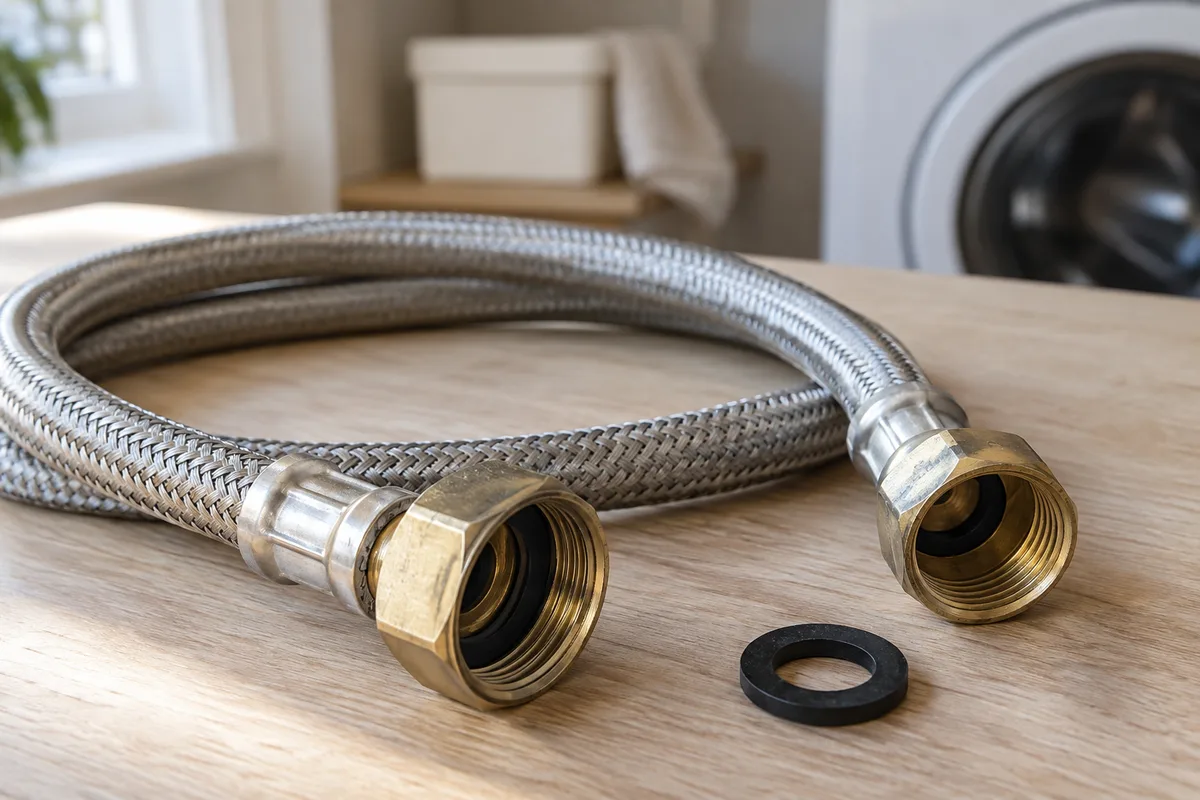
to resist kinking and crimping. That is more layers than a plain rubber hose. Brass nuts
thread on smooth and take a wrench flat without cracking, which is more than can be said
for the plastic-nut hoses that ship with new washers.
Color-coded collars keep hot and cold straight behind the machine. Buy the pair, write the
date on the collar, and put a five-year reminder on your calendar.
ConstructionStainless braid over PVC core
Fittings3/4 in female hose thread, brass nuts
Length and ends6 ft, 90-degree elbow
PackHot and cold pair
MarkingRed and blue collars
Skip it if: your valves sit close to the washer inlets. Six feet of hose will loop behind the machine, and the 5 ft elbow pair below is the shorter option.
Before buying: Match Eastman 48378: the 6 ft pair with 90-degree elbows and 3/4 in female hose thread on both ends. Measure valve to inlet before you order.
Affiliate link. As an Amazon Associate we earn from qualifying purchases. How this works.
Best for: the same job when the valves sit farther from the washer
Mid-range
Certified Appliance is the brand appliance installers actually carry on the truck, and the
useful thing here is the six-foot reach. If your valve box sits high on the wall or the
washer lives across an alcove, this pair reaches without splicing two hoses
together, which is a thing people genuinely try and a joint you do not want under
permanent pressure.
Construction quality matches the Eastman closely. Between the two, buy on the length your
laundry room needs and whichever pair is in stock.
ConstructionBraided stainless, PVC core
Fittings3/4 in female garden hose thread
Length6 ft
PackHot and cold pair
CertificationUPC, NSF 61 and CSA B125, per listing
Skip it if: a shorter pair already reaches your valves. Extra length you do not need is just a loop collecting lint.
03
Eastman 5 ft Pair with 90-Degree Elbows
Best for: washers pushed tight to the wall, stacked units, and shallow laundry closets
Mid-range
A straight hose leaving the back of a washer needs several inches to curve without
kinking. In a laundry closet, those inches do not exist, so the hose gets crushed against
the drywall the day the machine slides back. The 90-degree elbow ends solve it: the hose
leaves the inlet flat against the cabinet and drops straight down, and the washer sits
inches closer to the wall.
Kinked supply hoses fail early because the kink point flexes with every fill cycle. If
your washer lives in a closet, the elbow pair is not a luxury, it is the correct part.
ConstructionStainless braid over PVC core
Ends90-degree elbow on one end
Fittings3/4 in female hose thread
Length5 ft pair
Other lengthsEastman also lists 4 ft and 6 ft pairs
Skip it if: you have a deep laundry room with room to spare behind the machine. Straight ends are one less fitting to seat.
04
Flood Safe Auto-Shutoff Pair
Best for: laundry rooms above finished space, where a failed hose can reach a ceiling
Mid-range
This pair wraps the pressure hose in a second, corrugated tube. The seller says a built-in
valve shuts off the water if the inner tube leaks into the space between the two walls. No
batteries, no app. That covers one failure path. A leak at a threaded connection falls
outside the seller's description.
Check your washer's manual before you buy. LG's WM8900HBA manual (PDF, p. 12),
for example, says not to use flood-preventing hoses with auto shut-off devices because
they can trip during fill. A shutoff hose also ages like any hose, so the five-year
replacement interval still applies. Where the washer allows it, pair it with a leak sensor on the drain pan as the second layer.
ConstructionPVC hose inside a corrugated outer tube
MechanismValve shuts off if the inner tube leaks, per seller
Fittings3/4 in female hose thread, 90-degree elbow
Length5 ft pair
StandardsASME A112.18.6/CSA B125.6 and NSF 61, per seller
Skip it if: your washer is in the basement next to a floor drain, or your washer's manual rules out auto-shutoff hoses.
Before buying: Match the Flood Safe 5 ft pair with 90-degree elbow ends, and confirm your washer's manual allows auto-shutoff hoses before you order.
Affiliate link. As an Amazon Associate we earn from qualifying purchases. How this works.
Best for: owners who want heavy rubber hose and a long warranty, and will confirm its terms
Premium
FloodChek takes the opposite approach to the braided pack: instead of a jacket over a thin
liner, it is one massively overbuilt rubber hose with permanently crimped brass ends, the
way hydraulic shop hoses are made. FloodChek has advertised a 20-year warranty that
replaces both hoses if one fails from a defect in design, materials or workmanship. The
company's website no longer carries those terms, so confirm the current warranty with the
seller.
A long warranty is not a replacement schedule. Washer makers give five years for inlet
hoses without an exception for long-warranty hoses, so follow your washer's manual. It
also costs more, and you may have to hunt for stock.
This link opens Amazon search results. Match the exact model and size before buying.
Skip it if: availability is spotty or the seller cannot confirm the warranty. The braided picks above do the same job for less. This is the enthusiast option.
02
How to choose
One thread, three decisions.
Match the thread, then check the rest. Most U.S. washers and laundry
valves use 3/4-inch garden hose thread, and GE Appliances calls 3/4 inch the standard hose connection.
Every pick here has that thread on both ends. Thread alone does not make a hose fit. Before
you order, check:
The distance from each valve to its washer inlet.
Straight or 90-degree elbow ends, against the space behind the washer.
Your washer's installation instructions. Some call for new hoses at install, and some rule out auto-shutoff hoses.
For an auto-shutoff hose, which end the maker says goes on the valve.
The exact listing. Length and end style can change between variants of the same hose.
Choice 1
Construction
Braided stainless over a reinforced inner hose is the right answer for most laundry rooms.
Auto-shutoff variants add a shutoff valve for laundry rooms above finished space, where the washer's manual allows them.
Measure valve to inlet and buy the shortest hose that connects with a relaxed arc.
A hose under tension pulls fittings; a hose with slack kinks.
Choice 3
Ends
Straight for open laundry rooms.
90-degree elbows when the machine must sit tight to the wall.
Supply hoses sit out of sight behind the machines.
However good the hose, pair it with a sensor. A burst is loud only if someone is home, and the laundry room leak detectors we like cost less than one load of ruined drywall.
Pipes thud every time the fill valve closes? A screw-on pair of water hammer arrestors installs at these same valves in ten minutes.
03
The 20-minute swap
Washer makers say every five years. Here is the whole job.
Whirlpool,
GE Appliances
and LG (PDF, p. 12)
each tell owners to replace washer inlet hoses every five years. GE applies the same
interval to its stainless braided hoses,
which it calls burst-resistant. LG adds a periodic check for cracks, leaks and wear.
Replace sooner if you find damage, and follow your own washer's manual where it differs.
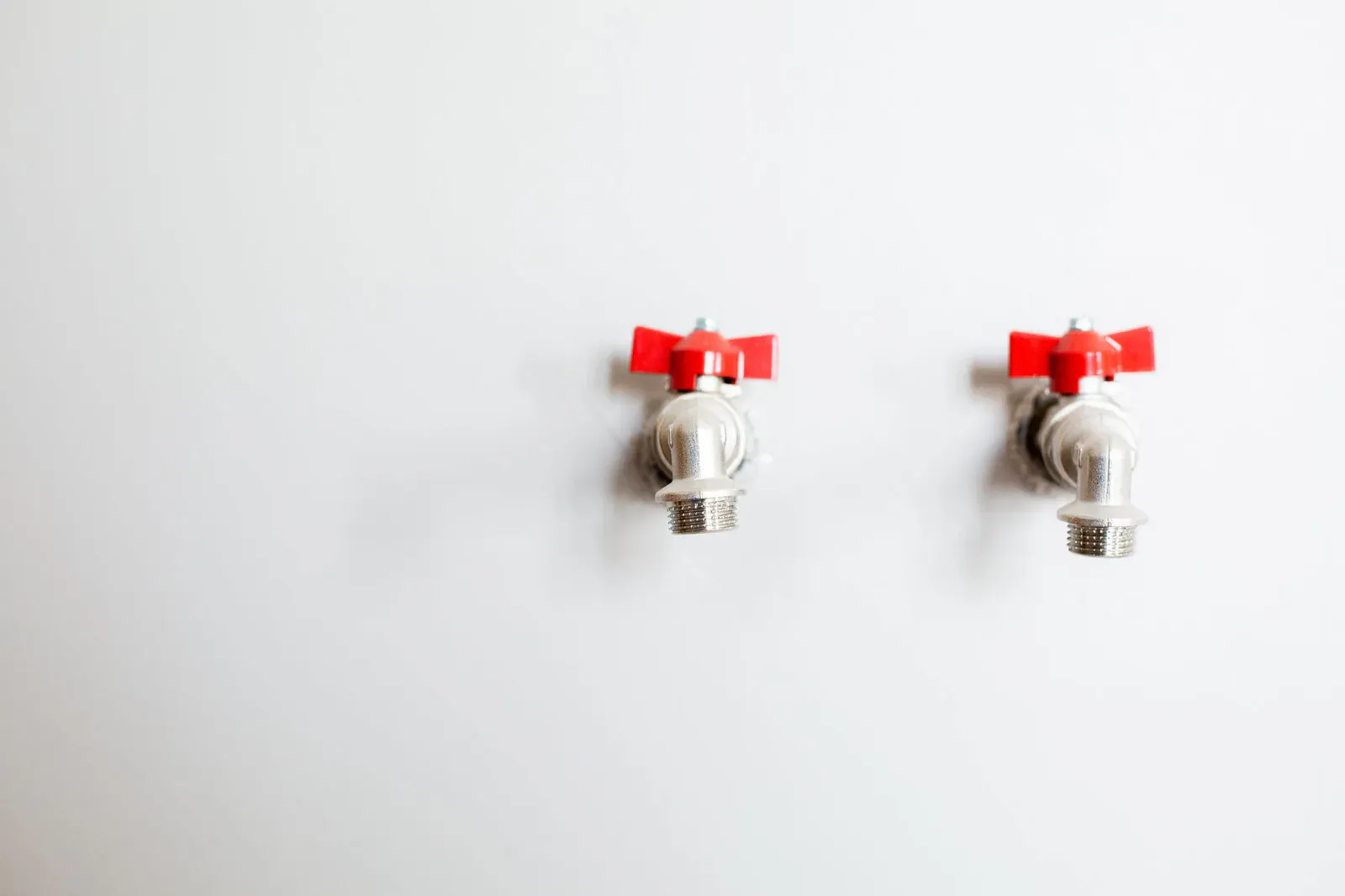
Both shutoff valves, hot and cold, close before the old hoses come off.
Kill the water and the cycle. Turn off both shutoff valves behind the washer, hot and cold. Run the washer on a fill setting for ten seconds to bleed pressure out of the old hoses, then unplug the machine.
Pull the washer forward. Walk it out far enough to work, a foot or two. Keep a towel and a small bucket handy: the old hoses hold a cup or so of water each.
Remove the old hoses. Hose nuts turn counterclockwise. Use channel locks if they fight you, and steady the valve body with your other hand so you are not twisting the pipe in the wall. Note which valve is hot; it is usually the left.
Install the new pair. Check that the rubber washer sits inside each hose nut, then thread each nut on by hand and finish with the extra turn your washer or hose instructions give. LG's manual linked above, for example, says hand-tight plus another two-thirds turn with pliers. The rubber washer does the sealing, so do not force the nut past that. Hot hose to the hot valve and inlet, cold to cold; if the hoses have colored collars, red marks hot and blue marks cold.
Pressurize and inspect. Open both valves slowly and watch each fitting for a minute. A weep means the washer is cocked: back the nut off, reseat, retighten. Slide the machine back without crushing the hoses and write the date on a collar. Check them for bulges, cracks, kinks and leaks whenever you pull the washer out, and replace the pair at five years.
04
Washer hose questions
Sizes, threads, and lifespan.
Are washing machine hoses universal?
At the thread, mostly. Most U.S. washers and laundry shutoff valves use 3/4-inch garden hose thread (GHT), the same thread as an outdoor spigot, and every hose on this page has it on both ends. Thread is not the whole fit. Measure the length you need, choose straight or 90-degree elbow ends for the space behind the machine, and check your washer's manual for hoses it requires or rules out, such as auto-shutoff hoses.
What size are washing machine hoses?
On most U.S. washers the fitting is 3/4-inch GHT. Common lengths run 4 to 6 feet, and GE Appliances lists 4 feet as its standard length. Measure the path from valve to washer inlet and buy the shortest length that connects without tension. Extra hose just kinks behind the machine.
How long do washing machine hoses last?
Plan on five years. Whirlpool, GE Appliances and LG all say to replace washer inlet hoses every five years, and GE gives the same interval for its stainless braided hoses. Replace them sooner if you find bulges, cracks, kinks, wear or leaks, and follow your own washer's manual if it says otherwise. A hose can look fine and still be due, so write the install date on the collar with a paint pen.
Are washing machine hoses reverse threaded?
No. Both ends are standard right-hand thread: righty-tighty, lefty-loosey. If a fitting will not turn, it is corroded or cross-threaded, not reversed. Hold the valve body steady with pliers while you turn the hose nut so you do not stress the pipe in the wall.
How many hoses does a washing machine have?
Three. Two supply hoses, hot and cold, which are the ones under constant pressure and worth upgrading. The third is the drain hose, which carries wastewater to the standpipe and is not pressurized. The picks here are supply hoses; drain hoses are machine-specific and rarely fail the same way.